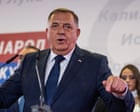
You can ban a politician from holding public office, but you cannot stop them from running the show. Milorad Dodik just proved that rule to the world. Despite a formal conviction and a state-mandated ban that kept his name off the official ballot, the Bosnian Serb nationalist strode up to a microphone in Banja Luka and declared a landslide victory for his party.
If you thought legal penalties or international pressure would sideline Europe's most defiant separatist leader, you weren't paying attention. Dodik is still calling the shots, his allies are sweeping major institutional seats, and the fragile architecture of the Dayton Peace Agreement is straining under the weight of his rhetoric.
The Illusion of Political Exiles
Let's look at how we got here. Dodik was previously the president of Republika Srpska, the Serb-majority half of Bosnia and Herzegovina. Last year, courts convicted him of defying the decisions of the international high representative overseeing the 1995 peace accord. That conviction carried a ban from public office. Western diplomats popped champagne and assumed the problem was managed.
They were wrong.
Dodik simply ran his campaign from the sidelines, dominating every headline, rallying ethnic grievances, and turning his legal punishment into a badge of honor. With nearly ninety percent of votes counted, his proxy and close ally Željka Cvijanović crushed her competition with over fifty-five percent of the vote, securing a seat in Bosnia's tripartite presidency. His party also locked down a vast majority in the Republika Srpska assembly.
The strategy backfired spectacularly for those hoping to quiet him. Dodik didn't fade into political obscurity. He used the ban to energize his base, painting himself as a martyr fighting against Western interference and central government overreach in Sarajevo.
Why the Dayton Framework is Fracturing
Bosnia is governed by one of the most convoluted political systems on earth. Crafted in Dayton, Ohio, in 1995 to stop a war that killed over one hundred thousand people, the state splits power among three constituent peoples: Muslim Bosniaks, Orthodox Serbs, and Catholic Croats. It is a peace deal built on permanent ethnic balancing, and it creates an administrative nightmare.
Dodik has spent years poking holes in this machinery. At his final campaign rally, standing alongside the Russian ambassador, he didn't mince words. He called Bosnia a dead project, an impossible country that makes no sense.
That kind of talk resonates with voters exhausted by economic stagnation and endless political gridlock. Bosnia remains one of the poorest nations in Europe, plagued by high unemployment and a massive youth brain drain. When people see no economic future, they retreat to safe, predictable tribal politics. Politicians like Dodik know this playbook by heart. They manufacture external enemies to mask internal governance failures.
The Foreign Factor and Future Instability
You cannot understand modern Bosnian politics without looking abroad. Dodik openly leans on Moscow, crediting Russian support for his political survival. At the same time, he draws energy from shifting global political winds, nodding to right-wing populist movements elsewhere.
Meanwhile, Western diplomats are locked in ongoing standoffs over the future of the international high representative post in Sarajevo. The United States and European nations are struggling to find a unified stance, creating a geopolitical vacuum that local strongmen are more than happy to fill.
Turnout for this election sat at a dismal forty-two percent, dropping nearly eight points from the previous vote in 2022. That low number tells the real story. The majority of Bosnians aren't celebrating nationalist victories or ideological purity; they are simply exhausted. Young people continue packing their bags for Germany, Austria, and beyond, leaving behind an aging population trapped in a perpetual political standstill.
Dodik may have declared victory, but the structural crisis in Bosnia is deepening by the day. Stop expecting international court rulings or bureaucratic slaps on the wrist to fix a country that its own leaders openly declare dead. Until real economic opportunities replace ethnic fear-mongering, the cycle will simply repeat.