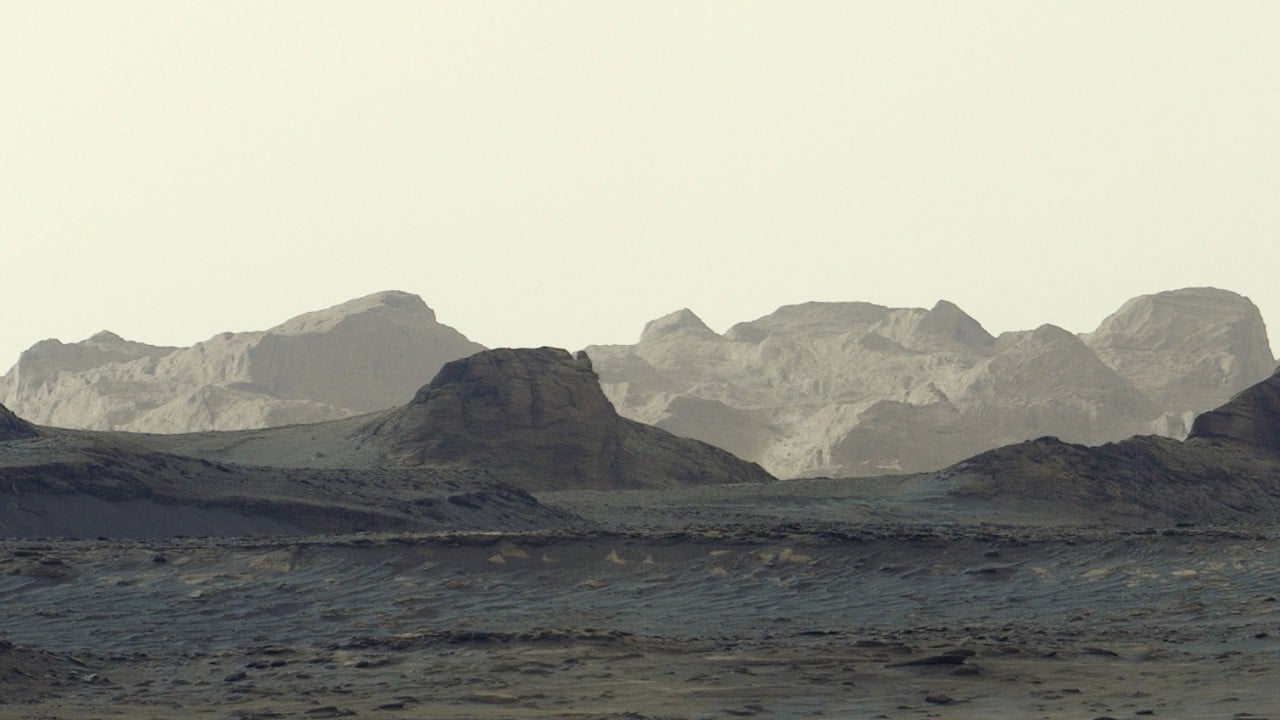
Morning light hits different on a world millions of miles away. NASA's Curiosity rover just proved that by sending back a breathtaking view of dawn on Mars, capturing sharp crags and wind-carved yardangs in Gale Crater that look startlingly like an Arizona desert until you notice the color of the sky.
If you look past the standard headlines, this photograph tells a deeper story about how humanity explores space today. Curiosity has been chugging across the Martian surface since 2012. It's old hardware by tech standards, yet it keeps delivering moments that stop planetary scientists in their tracks. Ashwin Vasavada, Curiosity project scientist at NASA's Jet Propulsion Laboratory, noted that the raw scene feels like a road trip through Monument Valley. But silence reigns, the sky glows orange, and the sunrise flashes with unexpected shades of blue. You might also find this similar article insightful: Why Ai Powered Robots Are Changing Modern Warfare Forever.
You might wonder why a single photo of a Martian sunrise makes news when we have dozens of orbiters snapping high-res images every single day. Ground-level panoramas hit differently. They offer a human-scale perspective. When you stare at those jagged rocks bathed in early light, you aren't just looking at geological data. You are standing right there on the dirt, experiencing the alien morning through the mechanical eyes of a car-sized robot.
What the Curiosity Rover Sees at Dawn
The image captures wind-sculpted ridges known as yardangs on Mount Sharp, the three-mile-high mountain rising from the center of Gale Crater. Billions of years ago, water shaped these slopes. Today, relentless winds scour the rock faces, leaving behind jagged monuments of ancient sediment. As highlighted in latest articles by Gizmodo, the implications are worth noting.
When the sun creeps over the horizon on Mars, the light behaves uniquely because of the fine dust suspended in the atmosphere. While Earth skies scatter blue light to give us azure days, Martian dust scatters red and orange wavelengths while casting a bluish halo directly around the solar disk during sunrise and sunset. It's backwards compared to home.
Curiosity captured this view on September 5, 2026, looking back across the crater floor just after hitting a major elevation milestone, having climbed over a kilometer up the flanks of Mount Sharp.
Why Planetary Sunrise Photos Matter for Science
Space agencies don't fund multi-billion-dollar rovers just to shoot pretty pictures for desktop wallpapers. Lighting angles matter immensely for geology. Low-angle morning light acts like a flashlight held sideways across a textured wall. Every tiny fracture, ripple, and pebble casts a long shadow, revealing subtle topography that vanishes under the harsh glare of noon.
Planetary geologists use these dawn captures to analyze strata layers, trace ancient wind directions, and spot mineral veins that might hold clues about past habitability. When the light strikes the yardangs at just the right angle, researchers can map out erosion rates and figure out how fast the Martian atmosphere is tearing down these ancient structures.
Meanwhile, on the other side of the planet, NASA's Perseverance rover operates in Jezero Crater, tackling different scientific questions about organic molecules and ancient river deltas. Having two active rovers on opposite sides of Mars gives scientists a dual-hemisphere baseline for tracking weather, seasonal dust storms, and atmospheric changes.
Bringing Mars Closer to Home
We live in an era where space imagery is so abundant that it's easy to scroll past a headline and forget what it actually represents. A machine built by human hands is sitting on a dead world, watching a blue sunrise over an orange sky, beaming those photons back across the void of space into your pocket.
Don't take it for granted. Check out the raw image feeds hosted by NASA to see these panoramas without color correction or cropping. Follow the daily sol counts. Realize that every pixel represents an engineering triumph born from decades of trial, error, and stubborn human curiosity.
Take a moment today to look up at your own sky, then remember there's an iron-oxide-stained desert out there watching right back.


