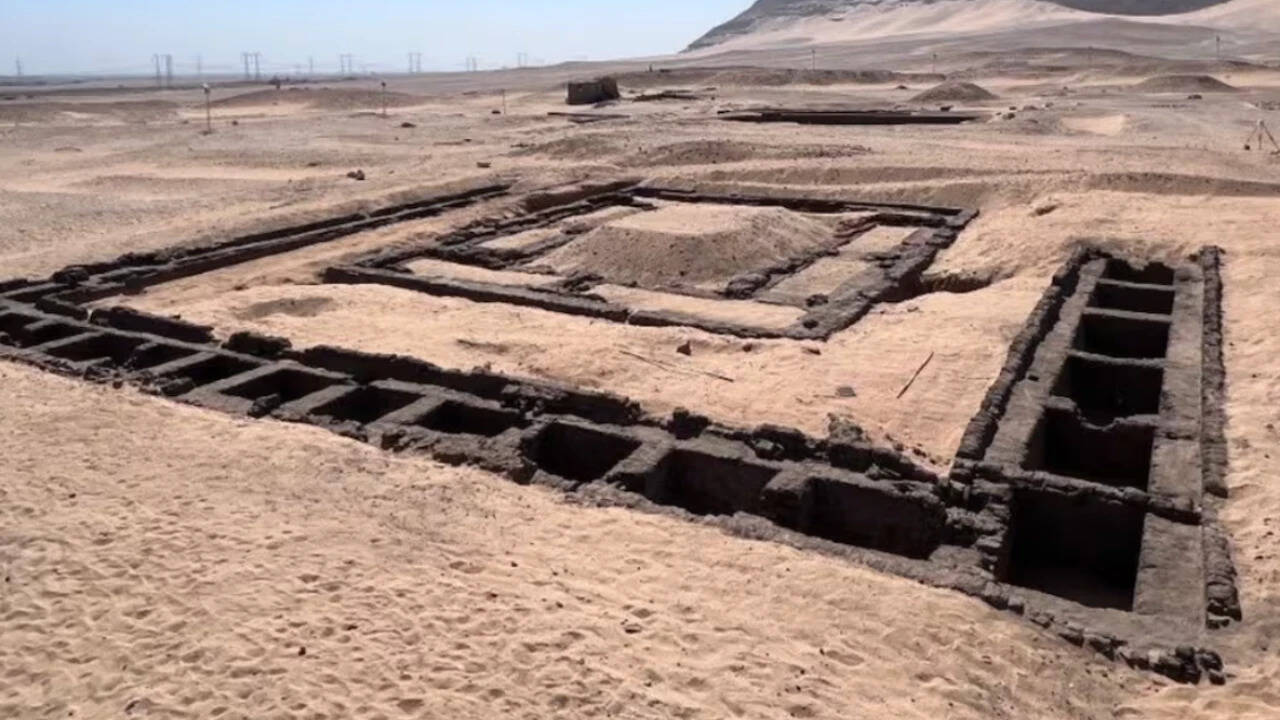
History loves a tidy narrative, but archaeology is often messy, brutal, and slow. For nearly a century, researchers have debated whether ancient Egypt’s earliest pharaohs dragged their servants, artisans, and courtiers into the grave with them. When British archaeologist Flinders Petrie excavated the First Dynasty royal cemetery at Abydos in the 1920s, he found hundreds of subsidiary graves surrounding the monumental tombs of kings who ruled around 3000 BCE. He suspected mass retainer sacrifice. But without obvious, fatal trauma on the bones, mainstream consensus remained skeptical.
That skepticism is cracking. A recent forensic re-examination of 46 surviving skulls from those exact 1920s excavations, published in the journal Frontiers in Environmental Archaeology, changes the conversation entirely. Dr. Roselyn Campbell and her team took a modern forensic lens to ancient bones housed in Cambridge University’s Duckworth Collection. Out of 46 skulls examined, 18 showed clear signs of significant cranial trauma. That means nearly 39 percent of the individuals represented in this sample bore physical marks consistent with violent, perimortem blows to the head.
If you've ever wondered how archaeologists can tell the difference between a natural break and a fatal blow after five millennia, the answer lies in forensic pathology. Flinders Petrie originally wrote off many of these cranial fractures as post-mortem damage—accidental breaks caused by shifting earth, time, and rough handling during excavation. Modern forensic science disagrees.
The re-analysis identified distinct linear fractures on the crania. These aren't the kind of crushed, depressed fractures you would expect from a heavy mace blow—which is famously depicted in Egyptian iconography when kings smite enemies. Instead, these linear breaks point to rapid, catastrophic force that would cause immediate unconsciousness, massive internal bleeding, and death. One individual even bore sharp-force trauma, featuring a distinct chopping injury near the eye socket.
This gives us concrete physical proof that wasn't available to archaeologists a hundred years ago. It moves retainer sacrifice at Abydos from an educated guess into the realm of hard forensic reality.
The Politics of Death in Early Dynastic Egypt
Why would a culture kill healthy, productive members of society just because a king died? To understand the practice, you have to look at the immense centralization of power during Egypt’s First Dynasty. Around 3000 BCE, Upper and Lower Egypt were united. The pharaoh wasn't just a political leader; he was viewed as a living god on earth. His transition to the afterlife wasn't a private family affair. It was a cosmic event that required maintaining the entire state apparatus, even in death.
Subsidiary graves at Abydos weren't chaotic dumps. They were meticulously organized in orderly rows. Some tombs were surrounded by hundreds of these secondary burials. Small marker tags found in the graves carried names or official titles, showing that these weren't nameless slaves. They were mid-level officials, craftsmen, and servants who had lived and worked directly within the royal household.
Did they go willingly? That's the eternal question. In some ancient cultures practicing retainer sacrifice, servants viewed dying alongside their master as the ultimate honor—a ticket to eternal glory and divine proximity in the next world. In other cases, coercion, poison, or blunt force applied behind closed doors kept order. The presence of sharp-force and blunt-force trauma on nearly 40 percent of the Cambridge sample suggests that force was definitely part of the equation for at least a portion of these retainers.
What the Skulls Don't Tell Us
Honesty matters in archaeology, and researchers are the first to admit that 18 skulls don't tell the whole story of the Abydos cemetery.
First, we are dealing with an incomplete sample. Most of the skeletons Petrie excavated a century ago were reburied at the site, leaving only a fraction of the skulls shipped to institutions like Cambridge. Second, skulls are only part of the skeleton. If retainers were killed via asphyxiation, strangulation, or poisons—methods that leave no marks on hard bone—they would appear completely healthy in a cranial examination.
Furthermore, some individuals buried around those royal tombs may have simply died of natural causes between major royal funerals, or succumbed to contemporary illnesses. Archaeology rarely hands you a clean 100 percent solution. What we have now is a compelling forensic anchor: we know for a fact that violent trauma occurred, and we know it happened right around the time of death.
Where Research Goes From Here
The study opens up urgent new avenues for bioarchaeology in the Nile Valley. If researchers could track down the reburied remains from Petrie's original digs or locate untouched subsidiary burials elsewhere in Abydos, full-body osteological scans could reveal hidden rib fractures, spinal damage, or chemical signatures of toxins.
Retainer sacrifice in Egypt didn't last forever. By the time of the Second Dynasty, the practice seems to have faded away, replaced by symbolic substitutes like shabti figurines—small servant statues meant to do the manual labor in the afterlife without requiring anyone to actually die.
When you look at the stones of Abydos today, you aren't just looking at cold monuments to the ego of early kings. You are looking at real people whose lives were abruptly cut short to fuel a divine political machine. Modern forensics has finally given a voice back to bones that have stayed silent for five thousand years.