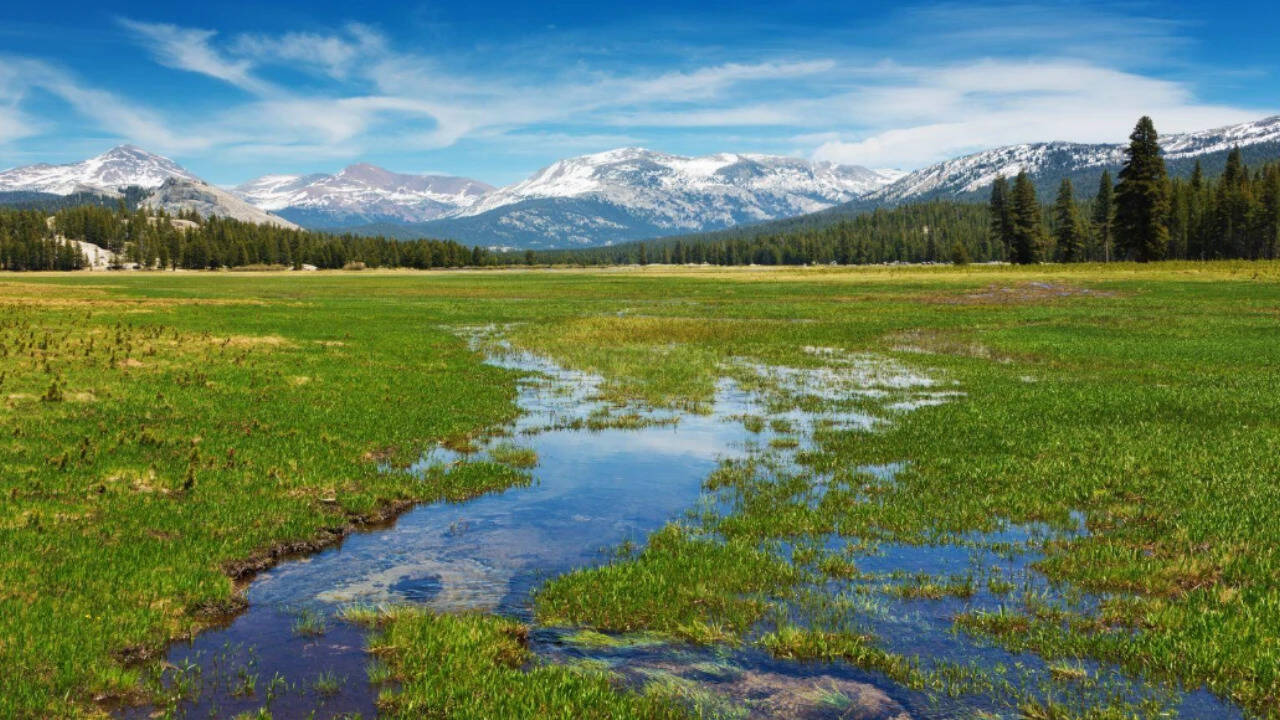
You can plant tens of thousands of native seedlings in a damaged mountain landscape, step back, and watch green shoots emerge. You can even measure incremental improvements in soil organic matter. But as researchers in Yosemite National Park recently discovered, nature doesn't hand out quick ecosystem fixes. Three years after crews dropped 40,000 native sedge seedlings into the bruised earth of Tuolumne Meadows, the ground was still bleeding carbon faster than it could trap it.
We love the narrative of ecological quick restoration. A headline tells us a park got thousands of plants, volunteers rolled up their sleeves, and habitat recovery is underway. Reality is infinitely messier. When centuries of heavy livestock grazing alter the fundamental chemistry and hydrology of a subalpine wet meadow, dropping in green starts is basically putting a band-aid on a broken bone.
The Long Shadow of Nineteenth-Century Sheep Grazing
To understand why Tuolumne Meadows remains broken despite active human intervention, you have to look backward past modern conservation efforts to the mid-1800s. Back then, vast flocks of sheep swept across California's high country. They didn't just wander through; they stripped the landscape bare. Long after Yosemite officially became a national park in 1890, grazing continued to ravage the native vegetation.
Those sheep decimated the native sedges. These aren't just ordinary grasses. In a high-altitude wet meadow, deep-rooted native sedges act as biological anchors. They lock moisture into the earth, build dense underground root networks, and quietly sequester massive amounts of carbon underground.
When sheep wiped them out, they didn't just disappear for a season. They vanished for good. Nature failed to bounce back on its own, even after grazing stopped completely over a century ago. Shallow-rooted, opportunistic plants moved into the vacuum. They lacked the dense root mass required to hold the sod together or regulate soil moisture.
Without those deep anchors, the upper layers of the meadow began to dry out and blow away. Today, more than twenty percent of the topsoil in parts of Tuolumne Meadows sits completely bare. Exposed to air and sun, the ancient organic matter trapped in that soil began to oxidize and break down, releasing stored carbon straight back into the atmosphere.
What Three Years of Monitoring Actually Revealed
Led by scientists at Colorado State University, a research team decided to bypass passive waiting and force the issue. They planted 40,000 native sedge seedlings directly into the degraded sections of Tuolumne Meadows, tracking the physical and chemical changes over a three-year period.
Their findings, published in the Journal of Geophysical Research: Biogeosciences, offer a sobering reality check for ecological restoration projects worldwide.
On the surface, things looked mildly hopeful. Soil organic matter was ticking upward. The newly introduced sedges took root, growing shoots and adding fresh organic debris to the upper soil layers. But soil health isn't a light switch. Even as new organic matter accumulated, the deep, historical reserves of old soil organic matter continued to decompose rapidly beneath the surface.
Because the baseline rate of decomposition outpaced the new carbon inputs from young plants, the ledger remained in the red. The meadow continued to emit more carbon dioxide than it absorbed.
David Cooper, a senior research scientist emeritus at Colorado State University and the study's lead author, put it bluntly. He noted that green plants returning to a site don't automatically mean a healed ecosystem. A landscape can look deceptively healthy on top while remaining profoundly broken underneath.
Why Full Recovery Takes Generations
If you're looking for a quick win, ecological restoration will break your heart. Cooper and his team estimate that reversing roughly 150 years of accumulated ecological damage in Tuolumne Meadows will realistically take between 25 and 50 years.
Rebuilding a complex subalpine wetland isn't just about sticking roots in the dirt. It requires rebuilding the entire hydrological sponge. When topsoil dries out and blows away, the water table drops. Without high water tables, sedges struggle to spread naturally. Without sedges, the soil continues to dry out and release carbon. It's a vicious feedback loop that takes decades of sustained, aggressive management to break.
Planting 40,000 seedlings was a massive operational undertaking. It proved that the right species can survive in the damaged soil and begin the slow work of healing. But it also demonstrated that carbon accounting in damaged ecosystems has a long memory. You cannot erase a century and a half of environmental degradation with a single weekend planting event.
Restoring places like Tuolumne Meadows requires acknowledging that time is the ultimate variable. Conservationists have to stop treating restoration as a finite project with a neat end date. It's an ongoing, generational commitment to nursing broken landscapes back to physiological health, one root at a time.