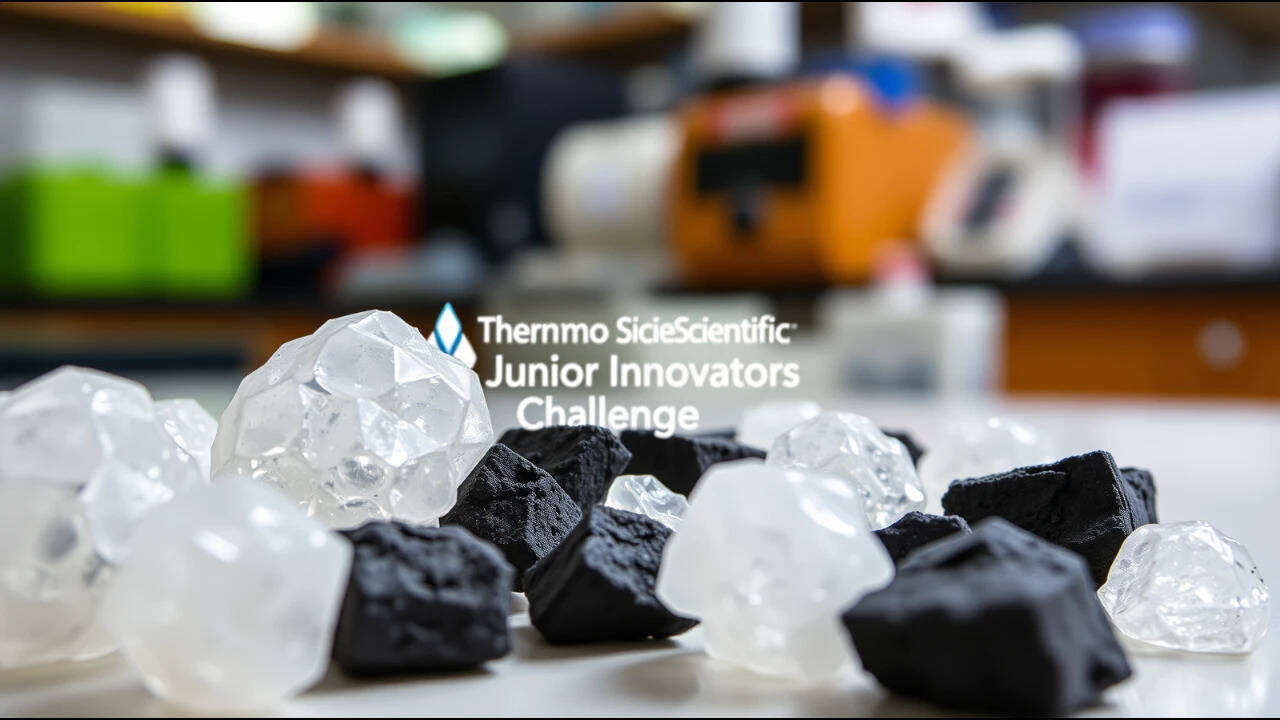
Wildfires don't always end when the towering flames finally die down. Long after the smoke clears, smoldering embers and hot charcoal briquettes can quietly reignite, sparking devastating new fire fronts days later. It's a stubborn problem that frustrates ground crews who simply can't haul enough water to soak every square inch of a burned zone.
Enter Henry and Jack Grover, twin eighth-graders from Riverside, California, who decided to tackle this exact dilemma. Instead of accepting that rekindling is just an inevitable hazard of modern wildfire seasons, the Riverside STEM Academy students spent months testing materials in a middle school science project that landed them among the top 30 finalists in the 2026 Thermo Fisher Scientific Junior Innovators Challenge.
If you're wondering how a couple of teenagers managed to outperform standard water sprays in controlled testing, you're looking at a clever mix of materials science and practical engineering.
Testing Nine Different Gels Under Pressure
The twins didn't just pick a random substance off a shelf. Their project, titled "Sprayable Hydrogels for Preventing the Rekindling of Wildfires," required evaluating nine candidate hydrogels to see how they handled drying, surface adhesion, and water absorption rates.
Hydrogels are fascinating because they can absorb hundreds of times their own weight in water and slowly release it over time. But not all hydrogels behave the same way when deployed. Henry and Jack put their candidates through rigorous evaluations. They monitored how the samples dried out in an oven, checked whether the gels could stick to vertically positioned leaves without instantly sliding off, and compared how quickly the top contenders reached full hydration.
Out of the group, sodium polyacrylate emerged as the clear front-runner, absorbing water completely in just 15 minutes.
Putting Hydrogels to the Test on Hot Charcoal
Knowing a material holds water is one thing. Proving it stops fire from coming back to life is another entirely.
The brothers tested their winning sodium polyacrylate formulation on hot charcoal briquettes to simulate smoldering post-wildfire debris. They compared the hydrogel-treated charcoal against standard water-sprayed briquettes. The results were stark. The water-treated charcoal reignited in a mere three minutes. Meanwhile, the charcoal treated with the hydrogel took a full 27 minutes to catch fire again.
That massive jump—stretching the window from three minutes to nearly half an hour—proves that moisture-retaining polymers can drastically slow down the thermal conditions that trigger secondary flare-ups.
Building a Better Delivery System
A great chemical formula is useless if you can't get it where it needs to go. Firefighters dealing with rough terrain need reach, and they need equipment that works in the field.
To solve this, the twins designed and 3D-printed a custom sprayer attachment that connects directly to a standard garden hose. In testing, their prototype successfully projected the hydrogel mixture up to 18.3 meters. While a 3D-printed nozzle attached to a garden hose isn't ready for a frontline Type 1 fire engine, it demonstrates an inventive approach to practical fluid delivery that scaled well beyond simple classroom setups.
What This Means for the Future of Fire Suppression
It's easy to romanticize science fair projects, but the core mechanics here point toward a wider conversation happening in forestry and environmental science. Traditional aerial and ground suppressants have faced increasing scrutiny over chemical residues and metal runoff. Researchers are actively exploring alternative, degradable, and efficient gelling agents that can suppress flames without leaving toxic footprints behind.
While the Grover twins' experiment used charcoal briquettes rather than a sprawling forest ecosystem, their work highlights a glaring gap in traditional firefighting tactics: holding the line after the initial blaze passes.
If future field applications can harness fast-hydrating, high-adhesion polymers safely and at scale, emergency crews might finally gain the upper hand against the silent threat of rekindling wildfires. Stop treating post-fire monitoring as an afterthought, and start looking at how material science can secure the perimeter before the wind shifts.