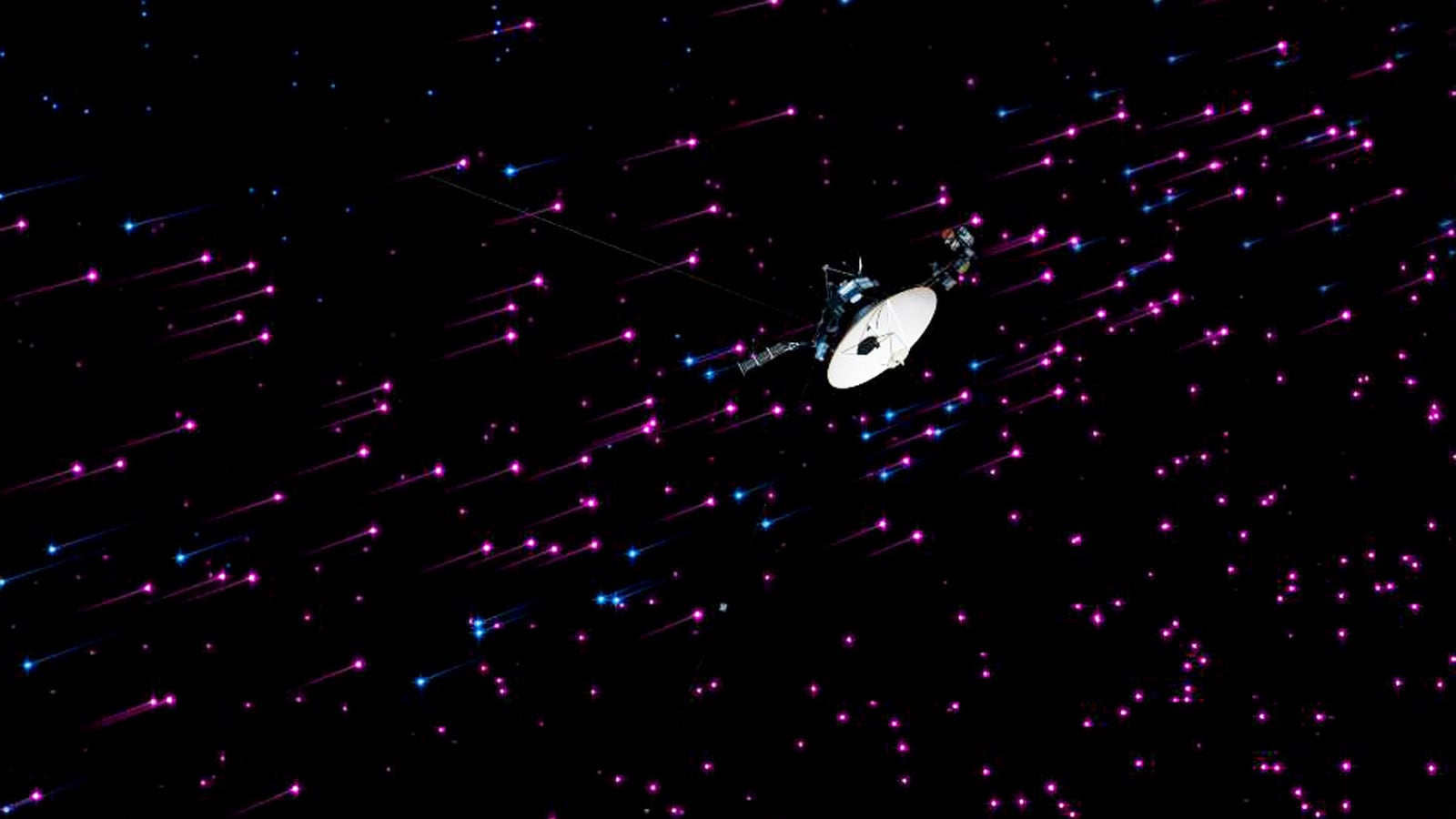
Forty-nine years ago, two small probes left Earth on a planetary joyride that was only supposed to last four years. Today, NASA's Voyager 1 is doing things physics textbooks barely whisper about. It is racing through interstellar space at roughly 38,000 miles per hour, pushing past 16 billion miles away from home.
And right now, it's crossing a threshold no human-made object has ever touched: a full light-day from Earth. For another look, read: this related article.
People love to talk about distance in miles or kilometers, but deep space breaks our brains. Numbers like 25.9 billion kilometers are just noise. Light-time changes that. When a radio signal leaves Earth to talk to Voyager 1, it has to travel for twenty-four hours straight at 186,000 miles per second just to reach the probe. If you send a command at breakfast today, the machine hears it at breakfast tomorrow.
That is not just far. That is completely staggering. Related analysis on this matter has been provided by ZDNet.
The Reality of 48-Hour Ping Times
Imagine debugging code when your error log takes two full days to get back to you.
Mission control at NASA's Jet Propulsion Laboratory deals with a round-trip light time of nearly forty-eight hours. Every glitch, every power-saving measure, and every engineering patch requires patience that modern software developers would find agonizing. When Voyager 1 starts acting up—like it did when its flight data subsystem went rogue—engineers can't just open a terminal and run a quick fix. They send a command into the dark, wait a day, cross their fingers, and wait another day to see if the machine survived.
It's a marvel that the probe is even alive. Launched in September 1977, Voyager 1 was built with computing power that makes your kitchen microwave look like a supercomputer. Its memory banks hold a fraction of a single modern smartphone photo. Yet, through clever software patches and creative use of surviving hardware, NASA's team keeps the generator-powered relic alive in a vacuum where temperatures drop to absolute zero.
What's Actually on the Golden Record
Of course, you can't talk about Voyager
Why Voyager 1 Leaving Our Solar System Still Blows My Mind
technology
Think about the fastest thing you can possibly imagine. Light travels at 186,282 miles per second. It flashes from the Moon to Earth in about a second and a half. It races across our entire solar system in a matter of hours. Now picture a tiny, metal-clad machine built in the 1970s that has drifted so far from home that light itself takes a full day to bridge the gap between it and us.
That machine is Voyager 1.
Most people hear about Voyager and think it is just a distant scrap of metal floating in empty darkness. They miss the sheer audacity of the engineering. When NASA launched these twin probes back in 1977, cassette tapes were cutting-edge technology, and your home computer had less processing power than a modern car key fob. Yet, Voyager 1 punched through the heliosphere and entered interstellar space in 2012, and it is still sending faint whispers back to Earth over fifteen billion miles away.
Let that sink in. Fifteen billion miles.
The Reality of Operating a Machine in Interstellar Space
Keeping Voyager 1 alive today is nothing short of an absolute headache for NASA engineers. You are talking about hardware that relies on dying plutonium power sources and commands traveling at the speed of light that take nearly a full day just to reach the spacecraft. When a glitch happens, you wait two days just to find out if your fix worked.
Recently, the team had to deal with a severe telemetry data loop where the flight data subsystem started spitting out absolute gibberish instead of science and engineering metrics. Imagine trying to troubleshoot a computer glitch on a device moving faster than a speeding bullet, located in deep space, using a manual written fifty years ago by engineers who have mostly retired or passed away. They pulled it off by rerouting old code, proving that brilliant engineering outlives its creators.
Why the Golden Record Is a Time Capsule That Actually Matters
Sure, the technical specs are wild, but the emotional core of the Voyager mission has always been the Golden Record. Carl Sagan and his committee packed a 12-inch gold-plated copper phonograph record onto each spacecraft, acting as a message in a bottle to the cosmos.
Critics call it a romantic waste of time. They argue that the chances of an intelligent alien civilization stumbling across a tiny probe in a galaxy filled with trillions of stars are roughly zero. But that misses the entire point. The Golden Record wasn't just built for aliens. It was built for us. It is a mirror reflecting what humanity valued at a very specific, fragile moment in the twentieth century.
On that record, you have greetings in fifty-five languages, the sound of a mother kissing her crying baby, whale songs, crickets, thunderstorms, and ninety minutes of global music ranging from Bach and Beethoven to traditional blind Willie Johnson blues. You also have encoded images showing our anatomy, our DNA, our architecture, and our food.
If humanity ever manages to wipe itself out with nuclear war or climate collapse, Voyager 1 and 2 will keep sailing through the quiet void of the Milky Way long after our cities have turned to dust. They are our longest-lasting footprints.
The Power Source is Dying and the End is Near
We need to talk about the clock ticking down. Voyager 1 runs on radioisotope thermoelectric generators, which convert the heat from decaying plutonium-238 into electricity. Every year, that power output drops by about four watts.
NASA engineers have had to make brutal choices to keep the instruments alive. They have turned off cabin heaters, scientific sensors, and attitude control thrusters just to squeeze a few more months of telemetry out of the aging bus. Eventually, the power will dip too low to keep the transmitter pointed at Earth. Sometime in the late 2020s or early 2030s, Voyager 1 will go completely silent.
It won't stop moving, though. Long after its radio signal dies, it will keep coasting toward the constellation Ophiuchus, passing star systems every few hundred thousand years.
What Voyager Teaches Us About Our Place in the Universe
We live in an era obsessed with instant gratification. We want our apps to load in milliseconds and our news feeds to update continuously. Voyager demands the exact opposite mindset. It requires deep time. It forces us to look past our daily anxieties and realize that a fragile species on a pale blue dot managed to build something tough enough to touch the stars.
Go outside tonight and look up at the dark sky. Somewhere out there in the freezing blackness, a tiny probe built with vacuum tubes and stubborn human grit is still dialing home, carrying the sound of crickets and a baby's cry into the dark.
Check your local science museum schedules for space exhibits, or dive into NASA's public mission logs to track Voyager's live distance metrics today.